The SafeFood4ClimDiet team will be at Microbes 2026 at Lyon with two oral presentations on Thursday, October 8, 2026. Both talks are part of session "Sustainable Microbiology", whose theme is "Climate change: from the vulnerability of ecosystems to that of health systems."
SP21-1 – Leveraging Large Language Models to Capture Emerging Food Practices Relevant to Microbial Risk Assessment under Climate Change by Mathieu Laï-King (post-doctoral researcher)
SP21-4 – Climate Change and Consumer Behavior: Identifying the Most Risky Food Practices from a Microbiological Perspective by Steve Nanema (PhD student)
Together, these two talks illustrate the project's approach: using text-mining and language models to detect emerging food practices, then ranking those practices according to the microbiological risks they may pose.
We look forward to discussing these results with the community. See you in the session!
We have created our second Knowledge pill about covered verandas in broiler production.
Provision of a covered veranda, also known as winter garden creates an intermediate environment — somewhere between the indoor house and the outdoors enabling birds to express natural behaviours such as foraging, perching, exploring or even sunbathing.
Do you want to know more? See the video here: https://www.youtube.com/watch?v=ql5QZ6b-Jow.
Have a look at our Broiler sub-page here.
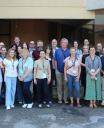
The EURL for Bee Health held its 16th annual workshop on 11th September 2026 in Bologna (Italy), following the EurBee conference. About forty participants attended, representing the NRLs of almost all EU Member States as well as of Norway and Switzerland. All participants were happy to gather, and the informal discussions were rich and lively.
The participants had the pleasure to listen to two presentations of NRLs' activities and the current honey bee health status in Portugal by Patrícia PEREIRA LOPES (representative of the Portuguese NRL) and in France by Stéphanie FRANCO (head of the French NRL).
Emilia SEMBERG (representative of the Swedish NRL) and Lotta KRISTIANSEN FABRICIUS (researcher at SLU Competence Centre for advisory services) shared the difficulties encountered with atypical cases of European foulbrood in Sweden.
This year, a focus was put on exotic pests. In the first session dedicated to Tropilaelaps spp., Cecilia COSTA (researcher at CREA-AA, Italy) presented the development of detection methods of Tropilaelaps mercedesae in Georgia. Then Marc SCHAEFER (head of the German NRL) and Michael OPITZ (representative of the Austrian NRL) presented the draft of the guidelines for Tropilaelaps surveillance, currently being developed by the EURL in collaboration with the representatives of five NRLs (Austria, Germany, Italy, the Netherlands, Spain), and discussed it with the participants. During the second session, Franco MUTINELLI (head of the Italian NRL) presented the surveillance of Aethina tumida in Italy, while Margot CAMOIN (Bee Health Division of GDS Réunion) presented the management of this pest in La Réunion island (France).
The workshop ended with the presentation of the EURL activities during the last period and the work perspectives for 2027.
We warmly thank all the speakers for their interesting presentations and all the contributors for the fruitful discussions. Many thanks also to the whole team of the EURL and Sophia Antipolis laboratory for their commitment in the preparation and organisation of this event.
Documents and presentations of the workshop can be found here for the NRL network.
The second joint Workshop of the 3 residues EURLs ANSES (Fougères, France), BVL (Berlin, Germany) and WFSR (Wageningen, The Netherlands) will take place from 15 to 17 June 2027 at the BVL in Berlin.
Invitations and further information will be issued in the first quarter of 2027. We look forward to seeing you in Berlin!
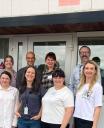
From 21 to 25 September, the EURL for Rabies were pleased to welcome colleagues from several regional veterinary laboratories in Ukraine colleagues from regional Ukrainian veterinary laboratories for a training course on rabies diagnosis. As Ukraine has experienced an increase in rabies cases in recent years, the training focused on several diagnostic tools, including the Fluorescent Antibody Test and molecular biology techniques. Beyond the technical aspects, these few days provided an excellent opportunity to share experiences, exchange laboratory practices, and strengthen international collaborations. Thank you to all participants for their engagement, interest, and valuable contributions throughout the training.
Review of rabies analysis oral route diagnosis and follow-up vaccination carried out in the NRLs in 2025 is now available on the website (under restricted access)!
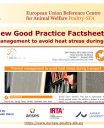
We are pleased to share a new Good Practice Factsheet focused on Thermal management to avoid heat stress during transport.
Take a look here!
See our Laying hens web-page here.
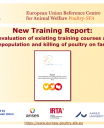
We are pleased to share a new Training report focused on the evaluation of existing training courses about depopulation and killing of poultry on farm
Take a look! https://doi.org/10.5281/zenodo.22640525
See our Poultry training web-page here.
The EU Reference Laboratory for Bee Health is pleased to share a preview of its new explainer video on Tropilaelaps spp.
This video is one of three short animated photomontages explaining the EURL for Bee Health's missions and the European regulatory framework in which it operates — illustrated here through a concrete, topical example: the EURL's support to National Reference Laboratories in strengthening diagnostic and surveillance capacities against Tropilaelaps spp.
This is a draft version — final subtitles in all 24 official EU languages, and the two remaining videos, will be released soon. Stay tuned!
Watch the preview on YouTube
We are pleased to announce that the SafeFood4ClimDiet project will be presented at FoodMicro 2026, the 31st international conference of the International Committee on Food Microbiology and Hygiene (ICFMH), held September 7-10, 2026, in Ljubljana, Slovenia. This year's edition, themed "Revisiting the Roots: Reviving Hygiene in Advancing Food Microbiology," brings together food microbiology experts, researchers, regulators and industry professionals from around the world to discuss sustainable food production, food safety and public health.
The project will be represented through two contributions:
Oral presentation : Thursday, September 10, in session S10: Different Perspectives on Challenging Topics of Food Microbiology in a Changing World
Steve Nanema (PhD student, SafeFood4ClimDiet) will present: "S10-RT5: Ranking Consumer Practices Related to Climate Change from a Microbiological Risk Perspective" (12:10–12:20)
Poster, displayed throughout the congress: "Mapping climate-related food practices: a data-driven framework to anticipate microbiological risks"
More information on the congress: foodmicro2026.icfmh.org