
EURL
European Union Reference Laboratory for
Bee Health

Stéphanie FRANCO1 and Véronique DUQUESNE1
1 French Agency for Food, Environmental and Occupational Health and Safety (ANSES), Sophia Antipolis Laboratory, Unit of Honeybee Pathology, Sophia Antipolis, France. (European Union Reference Laboratory for Bee Health and World Organisation for Animal Health Laboratory for Infestation of honey bees with Tropilaelaps spp.).
Contact: eurl.bee@anses.fr
To cite this note: Stéphanie Franco and Véronique Duquesne. 2026. “Geographical Spread of the Exotic Mite Tropilaelaps spp.: Suspected Presence in North-Eastern Turkey”. Scientific Note published on the website of the European Union Reference Laboratory for Bee Health on 24 August 2026.
This note presents an update of the geographical distribution and spread of Tropilaelaps spp. mites, parasites of bees and exotic in the European Union (EU), as of 24 August 2026. Previous states of play of the geographical distribution are available here.
The presence of Tropilaelaps spp. is suspected in the Artvin region of Turkey, close to the border with Georgia (Figure 1).
Description
On 26 July 2026, a video showing mites identified as Tropilaelaps spp. in a honey bee colony in the Artvin region of north-eastern Turkey was recorded by Dr. Asli Özkirim, a Turkish researcher. The video was subsequently shared on social media by PHIRA-Science1, a UK-based organisation actively involved in Tropilaelaps research.
The information was relayed by Apimondia2 on 14 August 2026. According to the available information, the mites observed in the video were identified as Tropilaelaps mercedesae. The images appear consistent with the morphological and behavioural characteristics of Tropilaelaps spp. and the number of mites observed suggests a relatively high level of infestation.
However, this information has not been officially confirmed by the Turkish authorities. No official notification of the presence of Tropilaelaps spp. in Türkiye has been identified to date.
The suspected presence is located in the Artvin region, in north-eastern Turkey, close to the border with Georgia (Figures 1). The presence of T. mercedesae was confirmed in Georgia in 2024, in the Samegrelo-Zemo Svaneti region, and the presence of Tropilaelaps spp. has also been suspected in the Samtskhe-Javakheti region, in southern Georgia near the Turkish border.
1https://www.facebook.com/share/r/1UrkejkjLJ/ https://www.instagram.com/reel/DbyDsXgx1G_/?igsh=aGJwY2phMGl4ZHBi&igsi=aGJwY2phMGl4ZHBi
2High risk of spreading of Tropilaelaps mercedesae in Eastern Europe, after new detection in Turkey. - APIMONDIA (accessed on 20/08/2026)
Discussion
To date, this suspicion has neither been confirmed by official analyses, nor has it been notified to the World Organisation for Animal Health (WOAH). No scientific publication confirming this occurrence is currently available. Therefore, this information should be considered with caution.
The available information does not allow an accurate assessment of the epidemiological situation in Turkey. In particular, it is not possible to determine the extent of the infestation or when the mite was introduced into the area. The relatively high number of mites observed in the video may suggest that the mite has been present for some time, but this cannot currently be confirmed.
However, the potential presence of Tropilaelaps spp. in north-eastern Turkey is of concern, given the westward spread of T. mercedesae and its increasing proximity to the European Union.
Turkey is a major beekeeping country, with a large number of honey bee colonies and extensive migratory beekeeping. Movements of colonies may contribute to the spread of Tropilaelaps spp.
The potential spread of Tropilaelaps spp. in regions neighbouring the EU constitutes an increasingly serious threat to the European beekeeping sector.
This calls for increased vigilance regarding movements of bees and beekeeping material, which are rapid spread routes for the parasite. Regulations on entry into the EU and movements between Member States help to reduce the risk of introduction.
Early detection is essential to allow rapid action and, if possible, eradicate the mite before it becomes established. Once Tropilaelaps spp. is well established, eradication is no longer possible.
In case of suspicion, competent authorities must be notified as soon as possible. Suspect mites should be immediately sent to the national reference laboratory and/or to the competent authority for confirmation and appropriate surveillance and control measures.
A leaflet on Tropilaelaps spp. for beekeepers is available on the EURL website.
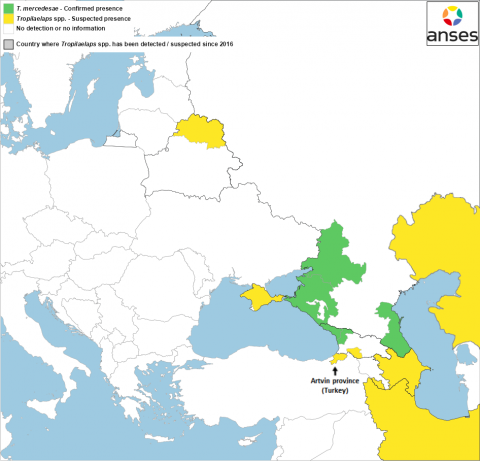
Figure 1 - Geographical distribution of Tropilaelaps spp. in territories close to the European continent as of 24 August 2026, with newly suspected occurrence in Artvin province, Turkey.
Explanation of the legend for Figures 1, 2 & 3: Confirmed presence: the presence of Tropilaelaps spp. has been officially reported to the WOAH and/or documented in a peer-reviewed scientific journal. Suspected presence: the presence of Tropilaelaps spp. has neither been officially reported to the WOAH nor published in a peer-reviewed journal. Instead, the information comes from informal sources such as beekeeping association websites, communications with scientists from affected countries, local media reports, or scientific publications in non–peer-reviewed journals.
Sources for Figures 1, 2 & 3: Anderson and Morgan 2007, Brandorf et al. 2024, Brandorf et al. 2025, Chantawannakul et al. 2016, de Guzman et al. 2017, Khokhlova 2023, Mohamadzade Namin et al. 2024, Joharchi and Stolbova 2024, Janashia et al. 2024, Goryachev and Kuzmich 2025, Sammataro et al. 2000, WOAH event notifications (WAHIS-WOAH consulted on 24 August 2026), information on the website of a local media outlet (regarding Azerbaijan), on the website of Apimondia and from social medias (Turkey) and personal communications with the Anses laboratory in Sophia Antipolis (regarding Georgia, Iran, Tajikistan, and Kazakhstan).
References
Anderson, D. L. and M. J. Morgan. 2007. "Genetic and morphological variation of bee-parasitic Tropilaelaps mites (Acari: Laelapidae): New and re-defined species." Experimental and Applied Acarology 43 (1): 1-24. https://doi.org/10.1007/s10493-007-9103-0 .
Brandorf, Anna, Marija M. Ivoilova, Orlando Yañez, Peter Neumann and Victoria Soroker. 2024. "First report of established mite populations, Tropilaelaps mercedesae, in Europe." Journal of Apicultural Research: 1-3. https://doi.org/10.1080/00218839.2024.2343976.
Brandorf A. Z., Xing’an L., Qingsheng N. 2025. “Infestation of Apis mellifera L. bee colonies by a mite of the genus Tropilaelaps spp. in the conditions of Russia.” Agrarnaya nauka Evro-Severo-Vostoka (Agricultural Science Euro-North-East): 26(3):663–670. (In Russ.). https://doi.org/10.30766/2072-9081.2025.26.3.663-670
Chantawannakul, P., L. I. de Guzman, J. Li and G. R. Williams. 2016. "Parasites, pathogens, and pests of honeybees in Asia." Apidologie 47 (3): 301-324. https://doi.org/10.1007/s13592-015-0407-5.
de Guzman, L. I., G. R. Williams, K. Khongphinitbunjong and P. Chantawannakul. 2017. "Ecology, Life History, and Management of Tropilaelaps Mites." Journal of economic entomology 110 (2): 319-332. https://doi.org/10.1093/jee/tow304.
Goryachev D.S. and Kuzmich E.G. 2025. Pests of honey bees in the Belarusian Lakeside Region.” Proceedings of an international scientific and practical conference for students, MScs, PhDs and young scientists, Vitebsk VGAVM 15-16 may 2025. (see pdf page 34)
Janashia, Irakli, Aleksandar Uzunov, Chao Chen, Cecilia Costa and Giovanni Cilia. 2024. "First report on Tropilaelaps mercedesae presence in Georgia: The mite is heading westward!" Journal of Apicultural Science. https://doi.org/10.2478/jas-2024-0010.
Joharchi, O. and V. V. Stolbova. 2024. "The first report on the ectoparasitic genus Tropilaelaps (Acari: Mesostigmata: Laelapidae) in Russia." Persian Journal of Acarology 13 (3): 513-516. https://www.biotaxa.org/pja/article/view/85545.
Khokhlova О. 2023. “Infestation of Apis mellifera by ectoparasites Varroa destructor and Tropilaelaps in the Crimea” Internauka 42 312:17–19. (see pdf page 18)
Mohamadzade Namin, Saeed, Omid Joharchi, Sunil Aryal, Ratna Thapa, Sun-Ho Kwon, Boymakhmat A. Kakhramanov and Chuleui Jung. 2024. "Exploring genetic variation and phylogenetic patterns of Tropilaelaps mercedesae (Mesostigmata: Laelapidae) populations in Asia." Frontiers in Ecology and Evolution 12. https://doi.org/10.3389/fevo.2024.1275995.
Sammataro, D., U. Gerson and G. Needham. 2000. "Parasitic mites of honey bees: life history, implications, and impact." Annu Rev Entomol 45: 519-48. https://doi.org/10.1146/annurev.ento.45.1.519.
World Organisation for Animal Health (WOAH). Consulted on 24/08/2026. World Animal Health Information System (WAHIS)